package cbor
import "github.com/fxamacker/cbor/v2"
Package cbor is a modern CBOR codec (RFC 8949 & RFC 7049) with CBOR tags, Go struct tags (toarray/keyasint/omitempty), Core Deterministic Encoding, CTAP2, Canonical CBOR, float64->32->16, and duplicate map key detection.
Encoding options allow "preferred serialization" by encoding integers and floats to their smallest forms (e.g. float16) when values fit.
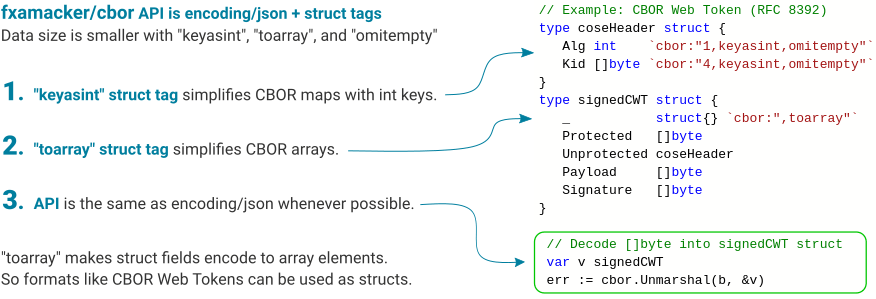
Struct tags like "keyasint", "toarray" and "omitempty" make CBOR data smaller and easier to use with structs.
For example, "toarray" tag makes struct fields encode to CBOR array elements. And "keyasint" makes a field encode to an element of CBOR map with specified int key.
Latest docs can be viewed at https://github.com/fxamacker/cbor#cbor-library-in-go
Basics
The Quick Start guide is at https://github.com/fxamacker/cbor#quick-start
Function signatures identical to encoding/json include:
Marshal, Unmarshal, NewEncoder, NewDecoder, (*Encoder).Encode, (*Decoder).Decode.
Standard interfaces include:
BinaryMarshaler, BinaryUnmarshaler, Marshaler, and Unmarshaler.
Custom encoding and decoding is possible by implementing standard interfaces for user-defined Go types.
Codec functions are available at package-level (using defaults options) or by creating modes from options at runtime.
"Mode" in this API means definite way of encoding (EncMode) or decoding (DecMode).
EncMode and DecMode interfaces are created from EncOptions or DecOptions structs.
em, err := cbor.EncOptions{...}.EncMode()
em, err := cbor.CanonicalEncOptions().EncMode()
em, err := cbor.CTAP2EncOptions().EncMode()
Modes use immutable options to avoid side-effects and simplify concurrency. Behavior of modes won't accidentally change at runtime after they're created.
Modes are intended to be reused and are safe for concurrent use.
EncMode and DecMode Interfaces
    // EncMode interface uses immutable options and is safe for concurrent use.
    type EncMode interface {
	Marshal(v interface{}) ([]byte, error)
	NewEncoder(w io.Writer) *Encoder
	EncOptions() EncOptions  // returns copy of options
    }

    // DecMode interface uses immutable options and is safe for concurrent use.
    type DecMode interface {
	Unmarshal(data []byte, v interface{}) error
	NewDecoder(r io.Reader) *Decoder
	DecOptions() DecOptions  // returns copy of options
    }
Using Default Encoding Mode
b, err := cbor.Marshal(v)

encoder := cbor.NewEncoder(w)
err = encoder.Encode(v)
Using Default Decoding Mode
err := cbor.Unmarshal(b, &v)

decoder := cbor.NewDecoder(r)
err = decoder.Decode(&v)
Creating and Using Encoding Modes
// Create EncOptions using either struct literal or a function.
opts := cbor.CanonicalEncOptions()

// If needed, modify encoding options
opts.Time = cbor.TimeUnix

// Create reusable EncMode interface with immutable options, safe for concurrent use.
em, err := opts.EncMode()

// Use EncMode like encoding/json, with same function signatures.
b, err := em.Marshal(v)
// or
encoder := em.NewEncoder(w)
err := encoder.Encode(v)

// NOTE: Both em.Marshal(v) and encoder.Encode(v) use encoding options
// specified during creation of em (encoding mode).
CBOR Options
Predefined Encoding Options: https://github.com/fxamacker/cbor#predefined-encoding-options
Encoding Options: https://github.com/fxamacker/cbor#encoding-options
Decoding Options: https://github.com/fxamacker/cbor#decoding-options
Struct Tags
Struct tags like `cbor:"name,omitempty"` and `json:"name,omitempty"` work as expected. If both struct tags are specified then `cbor` is used.
Struct tags like "keyasint", "toarray", and "omitempty" make it easy to use very compact formats like COSE and CWT (CBOR Web Tokens) with structs.
For example, "toarray" makes struct fields encode to array elements. And "keyasint" makes struct fields encode to elements of CBOR map with int keys.
https://raw.githubusercontent.com/fxamacker/images/master/cbor/v2.0.0/cbor_easy_api.png
Struct tags are listed at https://github.com/fxamacker/cbor#struct-tags-1
Tests and Fuzzing
Over 375 tests are included in this package. Cover-guided fuzzing is handled by
a private fuzzer that replaced fxamacker/cbor-fuzz years ago.
Code:
Output: Code:
Output: Code:
Output: Code:
Output: Code:
Output: Code:
Output: Code:
Example (COSE)
{
	// Use "keyasint" struct tag to encode/decode struct to/from CBOR map.
	// Use cbor.RawMessage to delay unmarshaling (CrvOrNOrK's data type depends on Kty's value).
	type coseKey struct {
		Kty       int             `cbor:"1,keyasint,omitempty"`
		Kid       []byte          `cbor:"2,keyasint,omitempty"`
		Alg       int             `cbor:"3,keyasint,omitempty"`
		KeyOpts   int             `cbor:"4,keyasint,omitempty"`
		IV        []byte          `cbor:"5,keyasint,omitempty"`
		CrvOrNOrK cbor.RawMessage `cbor:"-1,keyasint,omitempty"` // K for symmetric keys, Crv for elliptic curve keys, N for RSA modulus
		XOrE      cbor.RawMessage `cbor:"-2,keyasint,omitempty"` // X for curve x-coordinate, E for RSA public exponent
		Y         cbor.RawMessage `cbor:"-3,keyasint,omitempty"` // Y for curve y-cooridate
		D         []byte          `cbor:"-4,keyasint,omitempty"`
	}
	// Data from https://tools.ietf.org/html/rfc8392#appendix-A section A.2
	// 128-Bit Symmetric Key
	data, _ := hex.DecodeString("a42050231f4c4d4d3051fdc2ec0a3851d5b3830104024c53796d6d6574726963313238030a")
	var v coseKey
	if err := cbor.Unmarshal(data, &v); err != nil {
		fmt.Println("error:", err)
	}
	if _, err := cbor.Marshal(v); err != nil {
		fmt.Println("error:", err)
	}
	fmt.Printf("%+v", v)
	// Output:
	// {Kty:4 Kid:[83 121 109 109 101 116 114 105 99 49 50 56] Alg:10 KeyOpts:0 IV:[] CrvOrNOrK:[80 35 31 76 77 77 48 81 253 194 236 10 56 81 213 179 131] XOrE:[] Y:[] D:[]}
}
{Kty:4 Kid:[83 121 109 109 101 116 114 105 99 49 50 56] Alg:10 KeyOpts:0 IV:[] CrvOrNOrK:[80 35 31 76 77 77 48 81 253 194 236 10 56 81 213 179 131] XOrE:[] Y:[] D:[]}
Example (CWT)
{
	// Use "keyasint" struct tag to encode/decode struct to/from CBOR map.
	type claims struct {
		Iss string `cbor:"1,keyasint"`
		Sub string `cbor:"2,keyasint"`
		Aud string `cbor:"3,keyasint"`
		Exp int    `cbor:"4,keyasint"`
		Nbf int    `cbor:"5,keyasint"`
		Iat int    `cbor:"6,keyasint"`
		Cti []byte `cbor:"7,keyasint"`
	}
	// Data from https://tools.ietf.org/html/rfc8392#appendix-A section A.1
	data, _ := hex.DecodeString("a70175636f61703a2f2f61732e6578616d706c652e636f6d02656572696b77037818636f61703a2f2f6c696768742e6578616d706c652e636f6d041a5612aeb0051a5610d9f0061a5610d9f007420b71")
	var v claims
	if err := cbor.Unmarshal(data, &v); err != nil {
		fmt.Println("error:", err)
	}
	if _, err := cbor.Marshal(v); err != nil {
		fmt.Println("error:", err)
	}
	fmt.Printf("%+v", v)
	// Output:
	// {Iss:coap://as.example.com Sub:erikw Aud:coap://light.example.com Exp:1444064944 Nbf:1443944944 Iat:1443944944 Cti:[11 113]}
}
{Iss:coap://as.example.com Sub:erikw Aud:coap://light.example.com Exp:1444064944 Nbf:1443944944 Iat:1443944944 Cti:[11 113]}
Example (CWTWithDupMapKeyOption)
{
	type claims struct {
		Iss string `cbor:"1,keyasint"`
		Sub string `cbor:"2,keyasint"`
		Aud string `cbor:"3,keyasint"`
		Exp int    `cbor:"4,keyasint"`
		Nbf int    `cbor:"5,keyasint"`
		Iat int    `cbor:"6,keyasint"`
		Cti []byte `cbor:"7,keyasint"`
	}

	// Data from https://tools.ietf.org/html/rfc8392#appendix-A section A.1
	data, _ := hex.DecodeString("a70175636f61703a2f2f61732e6578616d706c652e636f6d02656572696b77037818636f61703a2f2f6c696768742e6578616d706c652e636f6d041a5612aeb0051a5610d9f0061a5610d9f007420b71")

	dm, _ := cbor.DecOptions{DupMapKey: cbor.DupMapKeyEnforcedAPF}.DecMode()

	var v claims
	if err := dm.Unmarshal(data, &v); err != nil {
		fmt.Println("error:", err)
	}
	fmt.Printf("%+v", v)
	// Output:
	// {Iss:coap://as.example.com Sub:erikw Aud:coap://light.example.com Exp:1444064944 Nbf:1443944944 Iat:1443944944 Cti:[11 113]}
}
{Iss:coap://as.example.com Sub:erikw Aud:coap://light.example.com Exp:1444064944 Nbf:1443944944 Iat:1443944944 Cti:[11 113]}
Example (SenML)
{
	// Use "keyasint" struct tag to encode/decode struct to/from CBOR map.
	type SenMLRecord struct {
		BaseName    string  `cbor:"-2,keyasint,omitempty"`
		BaseTime    float64 `cbor:"-3,keyasint,omitempty"`
		BaseUnit    string  `cbor:"-4,keyasint,omitempty"`
		BaseValue   float64 `cbor:"-5,keyasint,omitempty"`
		BaseSum     float64 `cbor:"-6,keyasint,omitempty"`
		BaseVersion int     `cbor:"-1,keyasint,omitempty"`
		Name        string  `cbor:"0,keyasint,omitempty"`
		Unit        string  `cbor:"1,keyasint,omitempty"`
		Time        float64 `cbor:"6,keyasint,omitempty"`
		UpdateTime  float64 `cbor:"7,keyasint,omitempty"`
		Value       float64 `cbor:"2,keyasint,omitempty"`
		ValueS      string  `cbor:"3,keyasint,omitempty"`
		ValueB      bool    `cbor:"4,keyasint,omitempty"`
		ValueD      string  `cbor:"8,keyasint,omitempty"`
		Sum         float64 `cbor:"5,keyasint,omitempty"`
	}
	// Data from https://tools.ietf.org/html/rfc8428#section-6
	data, _ := hex.DecodeString("87a721781b75726e3a6465763a6f773a3130653230373361303130383030363a22fb41d303a15b00106223614120050067766f6c7461676501615602fb405e066666666666a3006763757272656e74062402fb3ff3333333333333a3006763757272656e74062302fb3ff4cccccccccccda3006763757272656e74062202fb3ff6666666666666a3006763757272656e74062102f93e00a3006763757272656e74062002fb3ff999999999999aa3006763757272656e74060002fb3ffb333333333333")
	var v []*SenMLRecord
	if err := cbor.Unmarshal(data, &v); err != nil {
		fmt.Println("error:", err)
	}
	// Encoder uses ShortestFloat16 option to use float16 as the shortest form that preserves floating-point value.
	em, err := cbor.EncOptions{ShortestFloat: cbor.ShortestFloat16}.EncMode()
	if err != nil {
		fmt.Println("error:", err)
	}
	if _, err := em.Marshal(v); err != nil {
		fmt.Println("error:", err)
	}
	for _, rec := range v {
		fmt.Printf("%+v\n", *rec)
	}
	// Output:
	// {BaseName:urn:dev:ow:10e2073a0108006: BaseTime:1.276020076001e+09 BaseUnit:A BaseValue:0 BaseSum:0 BaseVersion:5 Name:voltage Unit:V Time:0 UpdateTime:0 Value:120.1 ValueS: ValueB:false ValueD: Sum:0}
	// {BaseName: BaseTime:0 BaseUnit: BaseValue:0 BaseSum:0 BaseVersion:0 Name:current Unit: Time:-5 UpdateTime:0 Value:1.2 ValueS: ValueB:false ValueD: Sum:0}
	// {BaseName: BaseTime:0 BaseUnit: BaseValue:0 BaseSum:0 BaseVersion:0 Name:current Unit: Time:-4 UpdateTime:0 Value:1.3 ValueS: ValueB:false ValueD: Sum:0}
	// {BaseName: BaseTime:0 BaseUnit: BaseValue:0 BaseSum:0 BaseVersion:0 Name:current Unit: Time:-3 UpdateTime:0 Value:1.4 ValueS: ValueB:false ValueD: Sum:0}
	// {BaseName: BaseTime:0 BaseUnit: BaseValue:0 BaseSum:0 BaseVersion:0 Name:current Unit: Time:-2 UpdateTime:0 Value:1.5 ValueS: ValueB:false ValueD: Sum:0}
	// {BaseName: BaseTime:0 BaseUnit: BaseValue:0 BaseSum:0 BaseVersion:0 Name:current Unit: Time:-1 UpdateTime:0 Value:1.6 ValueS: ValueB:false ValueD: Sum:0}
	// {BaseName: BaseTime:0 BaseUnit: BaseValue:0 BaseSum:0 BaseVersion:0 Name:current Unit: Time:0 UpdateTime:0 Value:1.7 ValueS: ValueB:false ValueD: Sum:0}
}
{BaseName:urn:dev:ow:10e2073a0108006: BaseTime:1.276020076001e+09 BaseUnit:A BaseValue:0 BaseSum:0 BaseVersion:5 Name:voltage Unit:V Time:0 UpdateTime:0 Value:120.1 ValueS: ValueB:false ValueD: Sum:0}
{BaseName: BaseTime:0 BaseUnit: BaseValue:0 BaseSum:0 BaseVersion:0 Name:current Unit: Time:-5 UpdateTime:0 Value:1.2 ValueS: ValueB:false ValueD: Sum:0}
{BaseName: BaseTime:0 BaseUnit: BaseValue:0 BaseSum:0 BaseVersion:0 Name:current Unit: Time:-4 UpdateTime:0 Value:1.3 ValueS: ValueB:false ValueD: Sum:0}
{BaseName: BaseTime:0 BaseUnit: BaseValue:0 BaseSum:0 BaseVersion:0 Name:current Unit: Time:-3 UpdateTime:0 Value:1.4 ValueS: ValueB:false ValueD: Sum:0}
{BaseName: BaseTime:0 BaseUnit: BaseValue:0 BaseSum:0 BaseVersion:0 Name:current Unit: Time:-2 UpdateTime:0 Value:1.5 ValueS: ValueB:false ValueD: Sum:0}
{BaseName: BaseTime:0 BaseUnit: BaseValue:0 BaseSum:0 BaseVersion:0 Name:current Unit: Time:-1 UpdateTime:0 Value:1.6 ValueS: ValueB:false ValueD: Sum:0}
{BaseName: BaseTime:0 BaseUnit: BaseValue:0 BaseSum:0 BaseVersion:0 Name:current Unit: Time:0 UpdateTime:0 Value:1.7 ValueS: ValueB:false ValueD: Sum:0}
Example (SignedCWT)
{
	// Use "keyasint" struct tag to encode/decode struct to/from CBOR map.
	// Partial COSE header definition
	type coseHeader struct {
		Alg int    `cbor:"1,keyasint,omitempty"`
		Kid []byte `cbor:"4,keyasint,omitempty"`
		IV  []byte `cbor:"5,keyasint,omitempty"`
	}
	// Use "toarray" struct tag to encode/decode struct to/from CBOR array.
	type signedCWT struct {
		_           struct{} `cbor:",toarray"`
		Protected   []byte
		Unprotected coseHeader
		Payload     []byte
		Signature   []byte
	}
	// Data from https://tools.ietf.org/html/rfc8392#appendix-A section A.3
	data, _ := hex.DecodeString("d28443a10126a104524173796d6d657472696345434453413235365850a70175636f61703a2f2f61732e6578616d706c652e636f6d02656572696b77037818636f61703a2f2f6c696768742e6578616d706c652e636f6d041a5612aeb0051a5610d9f0061a5610d9f007420b7158405427c1ff28d23fbad1f29c4c7c6a555e601d6fa29f9179bc3d7438bacaca5acd08c8d4d4f96131680c429a01f85951ecee743a52b9b63632c57209120e1c9e30")
	var v signedCWT
	if err := cbor.Unmarshal(data, &v); err != nil {
		fmt.Println("error:", err)
	}
	if _, err := cbor.Marshal(v); err != nil {
		fmt.Println("error:", err)
	}
	fmt.Printf("%+v", v)
	// Output:
	// {_:{} Protected:[161 1 38] Unprotected:{Alg:0 Kid:[65 115 121 109 109 101 116 114 105 99 69 67 68 83 65 50 53 54] IV:[]} Payload:[167 1 117 99 111 97 112 58 47 47 97 115 46 101 120 97 109 112 108 101 46 99 111 109 2 101 101 114 105 107 119 3 120 24 99 111 97 112 58 47 47 108 105 103 104 116 46 101 120 97 109 112 108 101 46 99 111 109 4 26 86 18 174 176 5 26 86 16 217 240 6 26 86 16 217 240 7 66 11 113] Signature:[84 39 193 255 40 210 63 186 209 242 156 76 124 106 85 94 96 29 111 162 159 145 121 188 61 116 56 186 202 202 90 205 8 200 212 212 249 97 49 104 12 66 154 1 248 89 81 236 238 116 58 82 185 182 54 50 197 114 9 18 14 28 158 48]}
}
{_:{} Protected:[161 1 38] Unprotected:{Alg:0 Kid:[65 115 121 109 109 101 116 114 105 99 69 67 68 83 65 50 53 54] IV:[]} Payload:[167 1 117 99 111 97 112 58 47 47 97 115 46 101 120 97 109 112 108 101 46 99 111 109 2 101 101 114 105 107 119 3 120 24 99 111 97 112 58 47 47 108 105 103 104 116 46 101 120 97 109 112 108 101 46 99 111 109 4 26 86 18 174 176 5 26 86 16 217 240 6 26 86 16 217 240 7 66 11 113] Signature:[84 39 193 255 40 210 63 186 209 242 156 76 124 106 85 94 96 29 111 162 159 145 121 188 61 116 56 186 202 202 90 205 8 200 212 212 249 97 49 104 12 66 154 1 248 89 81 236 238 116 58 82 185 182 54 50 197 114 9 18 14 28 158 48]}
Example (SignedCWTWithTag)
{
	// Use "keyasint" struct tag to encode/decode struct to/from CBOR map.
	// Partial COSE header definition
	type coseHeader struct {
		Alg int    `cbor:"1,keyasint,omitempty"`
		Kid []byte `cbor:"4,keyasint,omitempty"`
		IV  []byte `cbor:"5,keyasint,omitempty"`
	}
	// Use "toarray" struct tag to encode/decode struct to/from CBOR array.
	type signedCWT struct {
		_           struct{} `cbor:",toarray"`
		Protected   []byte
		Unprotected coseHeader
		Payload     []byte
		Signature   []byte
	}

	// Data from https://tools.ietf.org/html/rfc8392#appendix-A section A.3
	data, _ := hex.DecodeString("d28443a10126a104524173796d6d657472696345434453413235365850a70175636f61703a2f2f61732e6578616d706c652e636f6d02656572696b77037818636f61703a2f2f6c696768742e6578616d706c652e636f6d041a5612aeb0051a5610d9f0061a5610d9f007420b7158405427c1ff28d23fbad1f29c4c7c6a555e601d6fa29f9179bc3d7438bacaca5acd08c8d4d4f96131680c429a01f85951ecee743a52b9b63632c57209120e1c9e30")

	// Register tag COSE_Sign1 18 with signedCWT type.
	tags := cbor.NewTagSet()
	if err := tags.Add(
		cbor.TagOptions{EncTag: cbor.EncTagRequired, DecTag: cbor.DecTagRequired},
		reflect.TypeOf(signedCWT{}),
		18); err != nil {
		fmt.Println("error:", err)
	}

	dm, _ := cbor.DecOptions{}.DecModeWithTags(tags)
	em, _ := cbor.EncOptions{}.EncModeWithTags(tags)

	var v signedCWT
	if err := dm.Unmarshal(data, &v); err != nil {
		fmt.Println("error:", err)
	}

	if _, err := em.Marshal(v); err != nil {
		fmt.Println("error:", err)
	}
	fmt.Printf("%+v", v)
	// Output:
	// {_:{} Protected:[161 1 38] Unprotected:{Alg:0 Kid:[65 115 121 109 109 101 116 114 105 99 69 67 68 83 65 50 53 54] IV:[]} Payload:[167 1 117 99 111 97 112 58 47 47 97 115 46 101 120 97 109 112 108 101 46 99 111 109 2 101 101 114 105 107 119 3 120 24 99 111 97 112 58 47 47 108 105 103 104 116 46 101 120 97 109 112 108 101 46 99 111 109 4 26 86 18 174 176 5 26 86 16 217 240 6 26 86 16 217 240 7 66 11 113] Signature:[84 39 193 255 40 210 63 186 209 242 156 76 124 106 85 94 96 29 111 162 159 145 121 188 61 116 56 186 202 202 90 205 8 200 212 212 249 97 49 104 12 66 154 1 248 89 81 236 238 116 58 82 185 182 54 50 197 114 9 18 14 28 158 48]}
}
{_:{} Protected:[161 1 38] Unprotected:{Alg:0 Kid:[65 115 121 109 109 101 116 114 105 99 69 67 68 83 65 50 53 54] IV:[]} Payload:[167 1 117 99 111 97 112 58 47 47 97 115 46 101 120 97 109 112 108 101 46 99 111 109 2 101 101 114 105 107 119 3 120 24 99 111 97 112 58 47 47 108 105 103 104 116 46 101 120 97 109 112 108 101 46 99 111 109 4 26 86 18 174 176 5 26 86 16 217 240 6 26 86 16 217 240 7 66 11 113] Signature:[84 39 193 255 40 210 63 186 209 242 156 76 124 106 85 94 96 29 111 162 159 145 121 188 61 116 56 186 202 202 90 205 8 200 212 212 249 97 49 104 12 66 154 1 248 89 81 236 238 116 58 82 185 182 54 50 197 114 9 18 14 28 158 48]}
Example (WebAuthn)
{
	// Use cbor.RawMessage to delay unmarshaling (AttStmt's data type depends on Fmt's value).
	type attestationObject struct {
		AuthnData []byte          `cbor:"authData"`
		Fmt       string          `cbor:"fmt"`
		AttStmt   cbor.RawMessage `cbor:"attStmt"`
	}
	data, _ := hex.DecodeString("a363666d74686669646f2d7532666761747453746d74a26373696758483046022100e7ab373cfbd99fcd55fd59b0f6f17fef5b77a20ddec3db7f7e4d55174e366236022100828336b4822125fb56541fb14a8a273876acd339395ec2dad95cf41c1dd2a9ae637835638159024e3082024a30820132a0030201020204124a72fe300d06092a864886f70d01010b0500302e312c302a0603550403132359756269636f2055324620526f6f742043412053657269616c203435373230303633313020170d3134303830313030303030305a180f32303530303930343030303030305a302c312a302806035504030c2159756269636f205532462045452053657269616c203234393431343937323135383059301306072a8648ce3d020106082a8648ce3d030107034200043d8b1bbd2fcbf6086e107471601468484153c1c6d3b4b68a5e855e6e40757ee22bcd8988bf3befd7cdf21cb0bf5d7a150d844afe98103c6c6607d9faae287c02a33b3039302206092b0601040182c40a020415312e332e362e312e342e312e34313438322e312e313013060b2b0601040182e51c020101040403020520300d06092a864886f70d01010b05000382010100a14f1eea0076f6b8476a10a2be72e60d0271bb465b2dfbfc7c1bd12d351989917032631d795d097fa30a26a325634e85721bc2d01a86303f6bc075e5997319e122148b0496eec8d1f4f94cf4110de626c289443d1f0f5bbb239ca13e81d1d5aa9df5af8e36126475bfc23af06283157252762ff68879bcf0ef578d55d67f951b4f32b63c8aea5b0f99c67d7d814a7ff5a6f52df83e894a3a5d9c8b82e7f8bc8daf4c80175ff8972fda79333ec465d806eacc948f1bab22045a95558a48c20226dac003d41fbc9e05ea28a6bb5e10a49de060a0a4f6a2676a34d68c4abe8c61874355b9027e828ca9e064b002d62e8d8cf0744921753d35e3c87c5d5779453e7768617574684461746158c449960de5880e8c687434170f6476605b8fe4aeb9a28632c7995cf3ba831d976341000000000000000000000000000000000000000000408903fd7dfd2c9770e98cae0123b13a2c27828a106349bc6277140e7290b7e9eb7976aa3c04ed347027caf7da3a2fa76304751c02208acfc4e7fc6c7ebbc375c8a5010203262001215820ad7f7992c335b90d882b2802061b97a4fabca7e2ee3e7a51e728b8055e4eb9c7225820e0966ba7005987fece6f0e0e13447aa98cec248e4000a594b01b74c1cb1d40b3")
	var v attestationObject
	if err := cbor.Unmarshal(data, &v); err != nil {
		fmt.Println("error:", err)
	}
	if _, err := cbor.Marshal(v); err != nil {
		fmt.Println("error:", err)
	}
	fmt.Printf("%+v", v)
}
Index 
- func Diagnose(data []byte) (string, error)
- func DiagnoseFirst(data []byte) (string, []byte, error)
- func Marshal(v interface{}) ([]byte, error)
- func Unmarshal(data []byte, v interface{}) error
- func UnmarshalFirst(data []byte, v interface{}) (rest []byte, err error)
- func Valid(data []byte) error
- func Wellformed(data []byte) error
- type BigIntConvertMode
- type BigIntDecMode
- type ByteString
- func (bs ByteString) Bytes() []byte
- func (bs ByteString) MarshalCBOR() ([]byte, error)
- func (bs *ByteString) UnmarshalCBOR(data []byte) error
- type ByteStringEncoding
- type ByteStringToStringMode
- type DecMode
- type DecOptions
- func (opts DecOptions) DecMode() (DecMode, error)
- func (opts DecOptions) DecModeWithSharedTags(tags TagSet) (DecMode, error)
- func (opts DecOptions) DecModeWithTags(tags TagSet) (DecMode, error)
- type DecTagMode
- type Decoder
- func NewDecoder(r io.Reader) *Decoder
- func (dec *Decoder) Buffered() io.Reader
- func (dec *Decoder) Decode(v interface{}) error
- func (dec *Decoder) NumBytesRead() int
- func (dec *Decoder) Skip() error
- type DiagMode
- type DiagOptions
- type DupMapKeyError
- type DupMapKeyMode
- type EncMode
- type EncOptions
- func CTAP2EncOptions() EncOptions
- func CanonicalEncOptions() EncOptions
- func CoreDetEncOptions() EncOptions
- func PreferredUnsortedEncOptions() EncOptions
- func (opts EncOptions) EncMode() (EncMode, error)
- func (opts EncOptions) EncModeWithSharedTags(tags TagSet) (EncMode, error)
- func (opts EncOptions) EncModeWithTags(tags TagSet) (EncMode, error)
- type EncTagMode
- type Encoder
- func NewEncoder(w io.Writer) *Encoder
- func (enc *Encoder) Encode(v interface{}) error
- func (enc *Encoder) EndIndefinite() error
- func (enc *Encoder) StartIndefiniteArray() error
- func (enc *Encoder) StartIndefiniteByteString() error
- func (enc *Encoder) StartIndefiniteMap() error
- func (enc *Encoder) StartIndefiniteTextString() error
- type ExtraDecErrorCond
- type ExtraneousDataError
- type FieldNameByteStringMode
- type FieldNameMatchingMode
- type FieldNameMode
- type IndefLengthMode
- type IndefiniteLengthError
- type InfConvertMode
- type IntDecMode
- type InvalidMapKeyTypeError
- type InvalidUnmarshalError
- type MapKeyByteStringMode
- type Marshaler
- type MaxArrayElementsError
- type MaxMapPairsError
- type MaxNestedLevelError
- type NaNConvertMode
- type NilContainersMode
- type OmitEmptyMode
- type RawMessage
- func (m RawMessage) MarshalCBOR() ([]byte, error)
- func (m *RawMessage) UnmarshalCBOR(data []byte) error
- type RawTag
- type SemanticError
- type ShortestFloatMode
- type SimpleValue
- func (sv SimpleValue) MarshalCBOR() ([]byte, error)
- func (sv *SimpleValue) UnmarshalCBOR(data []byte) error
- type SortMode
- type StringMode
- type SyntaxError
- type Tag
- type TagOptions
- type TagSet
- type TagsMdError
- type TagsMode
- type TimeMode
- type UTF8Mode
- type UnknownFieldError
- type UnmarshalTypeError
- type Unmarshaler
- type UnrecognizedTagToAnyMode
- type UnsupportedTypeError
- type UnsupportedValueError
- type WrongTagError
Examples 
- package (COSE)
- package (CWT)
- package (CWTWithDupMapKeyOption)
- package (SenML)
- package (SignedCWT)
- package (SignedCWTWithTag)
- package (WebAuthn)
- Decoder
- Encoder
- Encoder (IndefiniteLengthArray)
- Encoder (IndefiniteLengthByteString)
- Encoder (IndefiniteLengthMap)
- Encoder (IndefiniteLengthTextString)
- Marshal
- Marshal (Canonical)
- Marshal (Keyasint)
- Marshal (Time)
- Marshal (Toarray)
- Unmarshal
- Unmarshal (Time)
Functions 
func Diagnose 
Diagnose returns extended diagnostic notation (EDN) of CBOR data items using the default diagnostic mode.
Refer to https://www.rfc-editor.org/rfc/rfc8949.html#name-diagnostic-notation.
func DiagnoseFirst 
Diagnose returns extended diagnostic notation (EDN) of the first CBOR data item using the DiagMode. Any remaining bytes are returned in rest.
func Marshal 
Marshal returns the CBOR encoding of v using default encoding options. See EncOptions for encoding options.
Marshal uses the following encoding rules:
If value implements the Marshaler interface, Marshal calls its MarshalCBOR method.
If value implements encoding.BinaryMarshaler, Marhsal calls its MarshalBinary method and encode it as CBOR byte string.
Boolean values encode as CBOR booleans (type 7).
Positive integer values encode as CBOR positive integers (type 0).
Negative integer values encode as CBOR negative integers (type 1).
Floating point values encode as CBOR floating points (type 7).
String values encode as CBOR text strings (type 3).
[]byte values encode as CBOR byte strings (type 2).
Array and slice values encode as CBOR arrays (type 4).
Map values encode as CBOR maps (type 5).
Struct values encode as CBOR maps (type 5). Each exported struct field becomes a pair with field name encoded as CBOR text string (type 3) and field value encoded based on its type. See struct tag option "keyasint" to encode field name as CBOR integer (type 0 and 1). Also see struct tag option "toarray" for special field "_" to encode struct values as CBOR array (type 4).
Marshal supports format string stored under the "cbor" key in the struct field's tag. CBOR format string can specify the name of the field, "omitempty" and "keyasint" options, and special case "-" for field omission. If "cbor" key is absent, Marshal uses "json" key.
Struct field name is treated as integer if it has "keyasint" option in its format string. The format string must specify an integer as its field name.
Special struct field "_" is used to specify struct level options, such as "toarray". "toarray" option enables Go struct to be encoded as CBOR array. "omitempty" is disabled by "toarray" to ensure that the same number of elements are encoded every time.
Anonymous struct fields are marshaled as if their exported fields were fields in the outer struct. Marshal follows the same struct fields visibility rules used by JSON encoding package.
time.Time values encode as text strings specified in RFC3339 or numerical representation of seconds since January 1, 1970 UTC depending on EncOptions.Time setting. Also See EncOptions.TimeTag to encode time.Time as CBOR tag with tag number 0 or 1.
big.Int values encode as CBOR integers (type 0 and 1) if values fit. Otherwise, big.Int values encode as CBOR bignums (tag 2 and 3). See EncOptions.BigIntConvert to always encode big.Int values as CBOR bignums.
Pointer values encode as the value pointed to.
Interface values encode as the value stored in the interface.
Nil slice/map/pointer/interface values encode as CBOR nulls (type 7).
Values of other types cannot be encoded in CBOR. Attempting
to encode such a value causes Marshal to return an UnsupportedTypeError.
Code:
Output: This example uses Marshal to encode struct and map in canonical form.
Code:
Output: This example uses "keyasint" struct tag to encode struct's fiele names as integer.
This feautre is very useful in handling COSE, CWT, SenML data.
Code:
Output: Code:
Output: This example uses "toarray" struct tag to encode struct as CBOR array.
Code:
Output:Example
{
	type Animal struct {
		Age    int
		Name   string
		Owners []string
		Male   bool
	}
	animal := Animal{Age: 4, Name: "Candy", Owners: []string{"Mary", "Joe"}}
	b, err := cbor.Marshal(animal)
	if err != nil {
		fmt.Println("error:", err)
	}
	fmt.Printf("%x\n", b)
	// Output:
	// a46341676504644e616d656543616e6479664f776e65727382644d617279634a6f65644d616c65f4
}
a46341676504644e616d656543616e6479664f776e65727382644d617279634a6f65644d616c65f4
Example (Canonical)
{
	type Animal struct {
		Age      int
		Name     string
		Contacts map[string]string
		Male     bool
	}
	animal := Animal{Age: 4, Name: "Candy", Contacts: map[string]string{"Mary": "111-111-1111", "Joe": "222-222-2222"}}
	em, err := cbor.CanonicalEncOptions().EncMode()
	if err != nil {
		fmt.Println("error:", err)
	}
	b, err := em.Marshal(animal)
	if err != nil {
		fmt.Println("error:", err)
	}
	fmt.Printf("%x\n", b)
	// Output:
	// a46341676504644d616c65f4644e616d656543616e647968436f6e7461637473a2634a6f656c3232322d3232322d32323232644d6172796c3131312d3131312d31313131
}
a46341676504644d616c65f4644e616d656543616e647968436f6e7461637473a2634a6f656c3232322d3232322d32323232644d6172796c3131312d3131312d31313131
Example (Keyasint)
{
	type Record struct {
		Name        string `cbor:"1,keyasint"`
		Unit        string `cbor:"2,keyasint"`
		Measurement int    `cbor:"3,keyasint"`
	}
	rec := Record{Name: "current", Unit: "V", Measurement: 1}
	b, err := cbor.Marshal(rec)
	if err != nil {
		fmt.Println("error:", err)
	}
	fmt.Printf("%x\n", b)
	// Output:
	// a3016763757272656e740261560301
}
a3016763757272656e740261560301
Example (Time)
{
	tm, _ := time.Parse(time.RFC3339, "2013-03-21T20:04:00Z")

	// Encode time as string in RFC3339 format with second precision.
	em, err := cbor.EncOptions{Time: cbor.TimeRFC3339}.EncMode()
	if err != nil {
		fmt.Println("error:", err)
	}
	b, err := em.Marshal(tm)
	if err != nil {
		fmt.Println("error:", err)
	}
	fmt.Printf("%x\n", b)

	// Encode time as numerical representation of seconds since January 1, 1970 UTC.
	em, err = cbor.EncOptions{Time: cbor.TimeUnix}.EncMode()
	if err != nil {
		fmt.Println("error:", err)
	}
	b, err = em.Marshal(tm)
	if err != nil {
		fmt.Println("error:", err)
	}
	fmt.Printf("%x\n", b)
	// Output:
	// 74323031332d30332d32315432303a30343a30305a
	// 1a514b67b0
}
74323031332d30332d32315432303a30343a30305a
1a514b67b0
Example (Toarray)
{
	type Record struct {
		_           struct{} `cbor:",toarray"`
		Name        string
		Unit        string
		Measurement int
	}
	rec := Record{Name: "current", Unit: "V", Measurement: 1}
	b, err := cbor.Marshal(rec)
	if err != nil {
		fmt.Println("error:", err)
	}
	fmt.Printf("%x\n", b)
	// Output:
	// 836763757272656e74615601
}
836763757272656e74615601
func Unmarshal 
Unmarshal parses the CBOR-encoded data into the value pointed to by v using default decoding options. If v is nil, not a pointer, or a nil pointer, Unmarshal returns an error.
To unmarshal CBOR into a value implementing the Unmarshaler interface, Unmarshal calls that value's UnmarshalCBOR method with a valid CBOR value.
To unmarshal CBOR byte string into a value implementing the encoding.BinaryUnmarshaler interface, Unmarshal calls that value's UnmarshalBinary method with decoded CBOR byte string.
To unmarshal CBOR into a pointer, Unmarshal sets the pointer to nil if CBOR data is null (0xf6) or undefined (0xf7). Otherwise, Unmarshal unmarshals CBOR into the value pointed to by the pointer. If the pointer is nil, Unmarshal creates a new value for it to point to.
To unmarshal CBOR into an empty interface value, Unmarshal uses the following rules:
CBOR booleans decode to bool.
CBOR positive integers decode to uint64.
CBOR negative integers decode to int64 (big.Int if value overflows).
CBOR floating points decode to float64.
CBOR byte strings decode to []byte.
CBOR text strings decode to string.
CBOR arrays decode to []interface{}.
CBOR maps decode to map[interface{}]interface{}.
CBOR null and undefined values decode to nil.
CBOR times (tag 0 and 1) decode to time.Time.
CBOR bignums (tag 2 and 3) decode to big.Int.
CBOR tags with an unrecognized number decode to cbor.Tag
To unmarshal a CBOR array into a slice, Unmarshal allocates a new slice if the CBOR array is empty or slice capacity is less than CBOR array length. Otherwise Unmarshal overwrites existing elements, and sets slice length to CBOR array length.
To unmarshal a CBOR array into a Go array, Unmarshal decodes CBOR array elements into Go array elements. If the Go array is smaller than the CBOR array, the extra CBOR array elements are discarded. If the CBOR array is smaller than the Go array, the extra Go array elements are set to zero values.
To unmarshal a CBOR array into a struct, struct must have a special field "_" with struct tag `cbor:",toarray"`. Go array elements are decoded into struct fields. Any "omitempty" struct field tag option is ignored in this case.
To unmarshal a CBOR map into a map, Unmarshal allocates a new map only if the map is nil. Otherwise Unmarshal reuses the existing map and keeps existing entries. Unmarshal stores key-value pairs from the CBOR map into Go map. See DecOptions.DupMapKey to enable duplicate map key detection.
To unmarshal a CBOR map into a struct, Unmarshal matches CBOR map keys to the keys in the following priority:
- "cbor" key in struct field tag,
- "json" key in struct field tag,
- struct field name.
Unmarshal tries an exact match for field name, then a case-insensitive match. Map key-value pairs without corresponding struct fields are ignored. See DecOptions.ExtraReturnErrors to return error at unknown field.
To unmarshal a CBOR text string into a time.Time value, Unmarshal parses text string formatted in RFC3339. To unmarshal a CBOR integer/float into a time.Time value, Unmarshal creates an unix time with integer/float as seconds and fractional seconds since January 1, 1970 UTC.
To unmarshal CBOR null (0xf6) and undefined (0xf7) values into a slice/map/pointer, Unmarshal sets Go value to nil. Because null is often used to mean "not present", unmarshalling CBOR null and undefined value into any other Go type has no effect and returns no error.
Unmarshal supports CBOR tag 55799 (self-describe CBOR), tag 0 and 1 (time), and tag 2 and 3 (bignum).
Unmarshal returns ExtraneousDataError error (without decoding into v)
if there are any remaining bytes following the first valid CBOR data item.
See UnmarshalFirst, if you want to unmarshal only the first
CBOR data item without ExtraneousDataError caused by remaining bytes.
Code:
Output: Code:
Output:Example
{
	type Animal struct {
		Age    int
		Name   string
		Owners []string
		Male   bool
	}
	data, _ := hex.DecodeString("a46341676504644e616d656543616e6479664f776e65727382644d617279634a6f65644d616c65f4")
	var animal Animal
	err := cbor.Unmarshal(data, &animal)
	if err != nil {
		fmt.Println("error:", err)
	}
	fmt.Printf("%+v", animal)
	// Output:
	// {Age:4 Name:Candy Owners:[Mary Joe] Male:false}
}
{Age:4 Name:Candy Owners:[Mary Joe] Male:false}
Example (Time)
{
	cborRFC3339Time, _ := hex.DecodeString("74323031332d30332d32315432303a30343a30305a")
	tm := time.Time{}
	if err := cbor.Unmarshal(cborRFC3339Time, &tm); err != nil {
		fmt.Println("error:", err)
	}
	fmt.Printf("%+v\n", tm.UTC().Format(time.RFC3339Nano))
	cborUnixTime, _ := hex.DecodeString("1a514b67b0")
	tm = time.Time{}
	if err := cbor.Unmarshal(cborUnixTime, &tm); err != nil {
		fmt.Println("error:", err)
	}
	fmt.Printf("%+v\n", tm.UTC().Format(time.RFC3339Nano))
	// Output:
	// 2013-03-21T20:04:00Z
	// 2013-03-21T20:04:00Z
}
2013-03-21T20:04:00Z
2013-03-21T20:04:00Z
func UnmarshalFirst 
UnmarshalFirst parses the first CBOR data item into the value pointed to by v using default decoding options. Any remaining bytes are returned in rest.
If v is nil, not a pointer, or a nil pointer, UnmarshalFirst returns an error.
See the documentation for Unmarshal for details.
func Valid 
Valid checks whether data is a well-formed encoded CBOR data item and that it complies with default restrictions such as MaxNestedLevels, MaxArrayElements, MaxMapPairs, etc.
If there are any remaining bytes after the CBOR data item, an ExtraneousDataError is returned.
WARNING: Valid doesn't check if encoded CBOR data item is valid (i.e. validity) and RFC 8949 distinctly defines what is "Valid" and what is "Well-formed".
Deprecated: Valid is kept for compatibility and should not be used. Use Wellformed instead because it has a more appropriate name.
func Wellformed 
Wellformed checks whether data is a well-formed encoded CBOR data item and that it complies with default restrictions such as MaxNestedLevels, MaxArrayElements, MaxMapPairs, etc.
If there are any remaining bytes after the CBOR data item, an ExtraneousDataError is returned.
Types 
type BigIntConvertMode 
type BigIntConvertMode int
BigIntConvertMode specifies how to encode big.Int values.
const (
	// BigIntConvertShortest makes big.Int encode to CBOR integer if value fits.
	// E.g. if big.Int value can be converted to CBOR integer while preserving
	// value, encoder will encode it to CBOR integer (major type 0 or 1).
	BigIntConvertShortest BigIntConvertMode = iota

	// BigIntConvertNone makes big.Int encode to CBOR bignum (tag 2 or 3) without
	// converting it to another CBOR type.
	BigIntConvertNone
)
type BigIntDecMode 
type BigIntDecMode int
BigIntDecMode specifies how to decode CBOR bignum to Go interface{}.
const (
	// BigIntDecodeValue makes CBOR bignum decode to big.Int (instead of *big.Int)
	// when unmarshalling into a Go interface{}.
	BigIntDecodeValue BigIntDecMode = iota

	// BigIntDecodePointer makes CBOR bignum decode to *big.Int when
	// unmarshalling into a Go interface{}.
	BigIntDecodePointer
)
type ByteString 
type ByteString string
ByteString represents CBOR byte string (major type 2). ByteString can be used when using a Go []byte is not possible or convenient. For example, Go doesn't allow []byte as map key, so ByteString can be used to support data formats having CBOR map with byte string keys. ByteString can also be used to encode invalid UTF-8 string as CBOR byte string. See DecOption.MapKeyByteStringMode for more details.
func (ByteString) Bytes 
func (bs ByteString) Bytes() []byte
Bytes returns bytes representing ByteString.
func (ByteString) MarshalCBOR 
func (bs ByteString) MarshalCBOR() ([]byte, error)
MarshalCBOR encodes ByteString as CBOR byte string (major type 2).
func (*ByteString) UnmarshalCBOR 
func (bs *ByteString) UnmarshalCBOR(data []byte) error
UnmarshalCBOR decodes CBOR byte string (major type 2) to ByteString. Decoding CBOR null and CBOR undefined sets ByteString to be empty.
type ByteStringEncoding 
type ByteStringEncoding uint8
ByteStringEncoding specifies the base encoding that byte strings are notated.
const (
	// ByteStringBase16Encoding encodes byte strings in base16, without padding.
	ByteStringBase16Encoding ByteStringEncoding = iota

	// ByteStringBase32Encoding encodes byte strings in base32, without padding.
	ByteStringBase32Encoding

	// ByteStringBase32HexEncoding encodes byte strings in base32hex, without padding.
	ByteStringBase32HexEncoding

	// ByteStringBase64Encoding encodes byte strings in base64url, without padding.
	ByteStringBase64Encoding
)
type ByteStringToStringMode 
type ByteStringToStringMode int
ByteStringToStringMode specifies the behavior when decoding a CBOR byte string into a Go string.
const (
	// ByteStringToStringForbidden generates an error on an attempt to decode a CBOR byte string into a Go string.
	ByteStringToStringForbidden ByteStringToStringMode = iota

	// ByteStringToStringAllowed permits decoding a CBOR byte string into a Go string.
	ByteStringToStringAllowed
)
type DecMode 
type DecMode interface {
	// Unmarshal parses the CBOR-encoded data into the value pointed to by v
	// using the decoding mode.  If v is nil, not a pointer, or a nil pointer,
	// Unmarshal returns an error.
	//
	// See the documentation for Unmarshal for details.
	Unmarshal(data []byte, v interface{}) error

	// UnmarshalFirst parses the first CBOR data item into the value pointed to by v
	// using the decoding mode.  Any remaining bytes are returned in rest.
	//
	// If v is nil, not a pointer, or a nil pointer, UnmarshalFirst returns an error.
	//
	// See the documentation for Unmarshal for details.
	UnmarshalFirst(data []byte, v interface{}) (rest []byte, err error)

	// Valid checks whether data is a well-formed encoded CBOR data item and
	// that it complies with configurable restrictions such as MaxNestedLevels,
	// MaxArrayElements, MaxMapPairs, etc.
	//
	// If there are any remaining bytes after the CBOR data item,
	// an ExtraneousDataError is returned.
	//
	// WARNING: Valid doesn't check if encoded CBOR data item is valid (i.e. validity)
	// and RFC 8949 distinctly defines what is "Valid" and what is "Well-formed".
	//
	// Deprecated: Valid is kept for compatibility and should not be used.
	// Use Wellformed instead because it has a more appropriate name.
	Valid(data []byte) error

	// Wellformed checks whether data is a well-formed encoded CBOR data item and
	// that it complies with configurable restrictions such as MaxNestedLevels,
	// MaxArrayElements, MaxMapPairs, etc.
	//
	// If there are any remaining bytes after the CBOR data item,
	// an ExtraneousDataError is returned.
	Wellformed(data []byte) error

	// NewDecoder returns a new decoder that reads from r using dm DecMode.
	NewDecoder(r io.Reader) *Decoder

	// DecOptions returns user specified options used to create this DecMode.
	DecOptions() DecOptions
}
DecMode is the main interface for CBOR decoding.
type DecOptions 
type DecOptions struct {
	// DupMapKey specifies whether to enforce duplicate map key.
	DupMapKey DupMapKeyMode

	// TimeTag specifies whether to check validity of time.Time (e.g. valid tag number and tag content type).
	// For now, valid tag number means 0 or 1 as specified in RFC 7049 if the Go type is time.Time.
	TimeTag DecTagMode

	// MaxNestedLevels specifies the max nested levels allowed for any combination of CBOR array, maps, and tags.
	// Default is 32 levels and it can be set to [4, 65535]. Note that higher maximum levels of nesting can
	// require larger amounts of stack to deserialize. Don't increase this higher than you require.
	MaxNestedLevels int

	// MaxArrayElements specifies the max number of elements for CBOR arrays.
	// Default is 128*1024=131072 and it can be set to [16, 2147483647]
	MaxArrayElements int

	// MaxMapPairs specifies the max number of key-value pairs for CBOR maps.
	// Default is 128*1024=131072 and it can be set to [16, 2147483647]
	MaxMapPairs int

	// IndefLength specifies whether to allow indefinite length CBOR items.
	IndefLength IndefLengthMode

	// TagsMd specifies whether to allow CBOR tags (major type 6).
	TagsMd TagsMode

	// IntDec specifies which Go integer type (int64 or uint64) to use
	// when decoding CBOR int (major type 0 and 1) to Go interface{}.
	IntDec IntDecMode

	// MapKeyByteString specifies how to decode CBOR byte string as map key
	// when decoding CBOR map with byte string key into an empty interface value.
	// By default, an error is returned when attempting to decode CBOR byte string
	// as map key because Go doesn't allow []byte as map key.
	MapKeyByteString MapKeyByteStringMode

	// ExtraReturnErrors specifies extra conditions that should be treated as errors.
	ExtraReturnErrors ExtraDecErrorCond

	// DefaultMapType specifies Go map type to create and decode to
	// when unmarshalling CBOR into an empty interface value.
	// By default, unmarshal uses map[interface{}]interface{}.
	DefaultMapType reflect.Type

	// UTF8 specifies if decoder should decode CBOR Text containing invalid UTF-8.
	// By default, unmarshal rejects CBOR text containing invalid UTF-8.
	UTF8 UTF8Mode

	// FieldNameMatching specifies how string keys in CBOR maps are matched to Go struct field names.
	FieldNameMatching FieldNameMatchingMode

	// BigIntDec specifies how to decode CBOR bignum to Go interface{}.
	BigIntDec BigIntDecMode

	// DefaultByteStringType is the Go type that should be produced when decoding a CBOR byte
	// string into an empty interface value. Types to which a []byte is convertible are valid
	// for this option, except for array and pointer-to-array types. If nil, the default is
	// []byte.
	DefaultByteStringType reflect.Type

	// ByteStringToString specifies the behavior when decoding a CBOR byte string into a Go string.
	ByteStringToString ByteStringToStringMode

	// FieldNameByteString specifies the behavior when decoding a CBOR byte string map key as a
	// Go struct field name.
	FieldNameByteString FieldNameByteStringMode

	// UnrecognizedTagToAny specifies how to decode unrecognized CBOR tag into an empty interface.
	// Currently, recognized CBOR tag numbers are 0, 1, 2, 3, or registered by TagSet.
	UnrecognizedTagToAny UnrecognizedTagToAnyMode
}
DecOptions specifies decoding options.
func (DecOptions) DecMode 
func (opts DecOptions) DecMode() (DecMode, error)
DecMode returns DecMode with immutable options and no tags (safe for concurrency).
func (DecOptions) DecModeWithSharedTags 
func (opts DecOptions) DecModeWithSharedTags(tags TagSet) (DecMode, error)
DecModeWithSharedTags returns DecMode with immutable options and mutable shared tags (safe for concurrency).
func (DecOptions) DecModeWithTags 
func (opts DecOptions) DecModeWithTags(tags TagSet) (DecMode, error)
DecModeWithTags returns DecMode with options and tags that are both immutable (safe for concurrency).
type DecTagMode 
type DecTagMode int
DecTagMode specifies how decoder handles tag number.
const (
	// DecTagIgnored makes decoder ignore tag number (skips if present).
	DecTagIgnored DecTagMode = iota

	// DecTagOptional makes decoder verify tag number if it's present.
	DecTagOptional

	// DecTagRequired makes decoder verify tag number and tag number must be present.
	DecTagRequired
)
type Decoder 
type Decoder struct {
	// contains filtered or unexported fields
}
Decoder reads and decodes CBOR values from io.Reader.
Code:
Output:Example
{
	type Animal struct {
		Age    int
		Name   string
		Owners []string
		Male   bool
	}
	data, _ := hex.DecodeString("a46341676504644d616c65f4644e616d656543616e6479664f776e65727382644d617279634a6f65a46341676506644d616c65f5644e616d656452756479664f776e657273816543696e6479a46341676502644d616c65f5644e616d656444756b65664f776e65727381664e6f72746f6e")
	dec := cbor.NewDecoder(bytes.NewReader(data))
	for {
		var animal Animal
		if err := dec.Decode(&animal); err != nil {
			if err != io.EOF {
				fmt.Println("error:", err)
			}
			break
		}
		fmt.Printf("%+v\n", animal)
	}
	// Output:
	// {Age:4 Name:Candy Owners:[Mary Joe] Male:false}
	// {Age:6 Name:Rudy Owners:[Cindy] Male:true}
	// {Age:2 Name:Duke Owners:[Norton] Male:true}
}
{Age:4 Name:Candy Owners:[Mary Joe] Male:false}
{Age:6 Name:Rudy Owners:[Cindy] Male:true}
{Age:2 Name:Duke Owners:[Norton] Male:true}
func NewDecoder 
NewDecoder returns a new decoder that reads and decodes from r using the default decoding options.
func (*Decoder) Buffered 
Buffered returns a reader for data remaining in Decoder's buffer. Returned reader is valid until the next call to Decode or Skip.
func (*Decoder) Decode 
Decode reads CBOR value and decodes it into the value pointed to by v.
func (*Decoder) NumBytesRead 
NumBytesRead returns the number of bytes read.
func (*Decoder) Skip 
Skip skips to the next CBOR data item (if there is any), otherwise it returns error such as io.EOF, io.UnexpectedEOF, etc.
type DiagMode 
type DiagMode interface {
	// Diagnose returns extended diagnostic notation (EDN) of CBOR data items using this DiagMode.
	Diagnose([]byte) (string, error)

	// DiagnoseFirst returns extended diagnostic notation (EDN) of the first CBOR data item using the DiagMode. Any remaining bytes are returned in rest.
	DiagnoseFirst([]byte) (string, []byte, error)

	// DiagOptions returns user specified options used to create this DiagMode.
	DiagOptions() DiagOptions
}
DiagMode is the main interface for CBOR diagnostic notation.
type DiagOptions 
type DiagOptions struct {
	// ByteStringEncoding specifies the base encoding that byte strings are notated.
	// Default is ByteStringBase16Encoding.
	ByteStringEncoding ByteStringEncoding

	// ByteStringHexWhitespace specifies notating with whitespace in byte string
	// when ByteStringEncoding is ByteStringBase16Encoding.
	ByteStringHexWhitespace bool

	// ByteStringText specifies notating with text in byte string
	// if it is a valid UTF-8 text.
	ByteStringText bool

	// ByteStringEmbeddedCBOR specifies notating embedded CBOR in byte string
	// if it is a valid CBOR bytes.
	ByteStringEmbeddedCBOR bool

	// CBORSequence specifies notating CBOR sequences.
	// otherwise, it returns an error if there are more bytes after the first CBOR.
	CBORSequence bool

	// FloatPrecisionIndicator specifies appending a suffix to indicate float precision.
	// Refer to https://www.rfc-editor.org/rfc/rfc8949.html#name-encoding-indicators.
	FloatPrecisionIndicator bool

	// MaxNestedLevels specifies the max nested levels allowed for any combination of CBOR array, maps, and tags.
	// Default is 32 levels and it can be set to [4, 65535]. Note that higher maximum levels of nesting can
	// require larger amounts of stack to deserialize. Don't increase this higher than you require.
	MaxNestedLevels int

	// MaxArrayElements specifies the max number of elements for CBOR arrays.
	// Default is 128*1024=131072 and it can be set to [16, 2147483647]
	MaxArrayElements int

	// MaxMapPairs specifies the max number of key-value pairs for CBOR maps.
	// Default is 128*1024=131072 and it can be set to [16, 2147483647]
	MaxMapPairs int
}
DiagOptions specifies Diag options.
func (DiagOptions) DiagMode 
func (opts DiagOptions) DiagMode() (DiagMode, error)
DiagMode returns a DiagMode with immutable options.
type DupMapKeyError 
type DupMapKeyError struct {
	Key   interface{}
	Index int
}
DupMapKeyError describes detected duplicate map key in CBOR map.
func (*DupMapKeyError) Error 
func (e *DupMapKeyError) Error() string
type DupMapKeyMode 
type DupMapKeyMode int
DupMapKeyMode specifies how to enforce duplicate map key.
const (
	// DupMapKeyQuiet doesn't enforce duplicate map key. Decoder quietly (no error)
	// uses faster of "keep first" or "keep last" depending on Go data type and other factors.
	DupMapKeyQuiet DupMapKeyMode = iota

	// DupMapKeyEnforcedAPF enforces detection and rejection of duplicate map keys.
	// APF means "Allow Partial Fill" and the destination map or struct can be partially filled.
	// If a duplicate map key is detected, DupMapKeyError is returned without further decoding
	// of the map. It's the caller's responsibility to respond to DupMapKeyError by
	// discarding the partially filled result if their protocol requires it.
	// WARNING: using DupMapKeyEnforcedAPF will decrease performance and increase memory use.
	DupMapKeyEnforcedAPF
)
type EncMode 
type EncMode interface {
	Marshal(v interface{}) ([]byte, error)
	NewEncoder(w io.Writer) *Encoder
	EncOptions() EncOptions
}
EncMode is the main interface for CBOR encoding.
type EncOptions 
type EncOptions struct {
	// Sort specifies sorting order.
	Sort SortMode

	// ShortestFloat specifies the shortest floating-point encoding that preserves
	// the value being encoded.
	ShortestFloat ShortestFloatMode

	// NaNConvert specifies how to encode NaN and it overrides ShortestFloatMode.
	NaNConvert NaNConvertMode

	// InfConvert specifies how to encode Inf and it overrides ShortestFloatMode.
	InfConvert InfConvertMode

	// BigIntConvert specifies how to encode big.Int values.
	BigIntConvert BigIntConvertMode

	// Time specifies how to encode time.Time.
	Time TimeMode

	// TimeTag allows time.Time to be encoded with a tag number.
	// RFC3339 format gets tag number 0, and numeric epoch time tag number 1.
	TimeTag EncTagMode

	// IndefLength specifies whether to allow indefinite length CBOR items.
	IndefLength IndefLengthMode

	// NilContainers specifies how to encode nil slices and maps.
	NilContainers NilContainersMode

	// TagsMd specifies whether to allow CBOR tags (major type 6).
	TagsMd TagsMode

	// OmitEmptyMode specifies how to encode struct fields with omitempty tag.
	OmitEmpty OmitEmptyMode

	// String specifies which CBOR type to use when encoding Go strings.
	// - CBOR text string (major type 3) is default
	// - CBOR byte string (major type 2)
	String StringMode

	// FieldName specifies the CBOR type to use when encoding struct field names.
	FieldName FieldNameMode
}
EncOptions specifies encoding options.
func CTAP2EncOptions 
func CTAP2EncOptions() EncOptions
CTAP2EncOptions returns EncOptions for "CTAP2 Canonical CBOR" encoding, defined in CTAP specification, with the following rules:
- "Integers must be encoded as small as possible."
- "The representations of any floating-point values are not changed."
- "The expression of lengths in major types 2 through 5 must be as short as possible."
- "Indefinite-length items must be made into definite-length items.""
- The keys in every map must be sorted in bytewise lexicographic order. See SortBytewiseLexical for details.
- "Tags as defined in Section 2.4 in [RFC7049] MUST NOT be present."
func CanonicalEncOptions 
func CanonicalEncOptions() EncOptions
CanonicalEncOptions returns EncOptions for "Canonical CBOR" encoding, defined in RFC 7049 Section 3.9 with the following rules:
- "Integers must be as small as possible."
- "The expression of lengths in major types 2 through 5 must be as short as possible."
- The keys in every map must be sorted in length-first sorting order. See SortLengthFirst for details.
- "Indefinite-length items must be made into definite-length items."
- "If a protocol allows for IEEE floats, then additional canonicalization rules might need to be added. One example rule might be to have all floats start as a 64-bit float, then do a test conversion to a 32-bit float; if the result is the same numeric value, use the shorter value and repeat the process with a test conversion to a 16-bit float. (This rule selects 16-bit float for positive and negative Infinity as well.) Also, there are many representations for NaN. If NaN is an allowed value, it must always be represented as 0xf97e00."
func CoreDetEncOptions 
func CoreDetEncOptions() EncOptions
CoreDetEncOptions returns EncOptions for "Core Deterministic" encoding, defined in RFC 7049bis with the following rules:
- "Preferred serialization MUST be used. In particular, this means that arguments (see Section 3) for integers, lengths in major types 2 through 5, and tags MUST be as short as possible" "Floating point values also MUST use the shortest form that preserves the value"
- "Indefinite-length items MUST NOT appear."
- "The keys in every map MUST be sorted in the bytewise lexicographic order of their deterministic encodings."
func PreferredUnsortedEncOptions 
func PreferredUnsortedEncOptions() EncOptions
PreferredUnsortedEncOptions returns EncOptions for "Preferred Serialization" encoding, defined in RFC 7049bis with the following rules:
- "The preferred serialization always uses the shortest form of representing the argument (Section 3);"
- "it also uses the shortest floating-point encoding that preserves the value being encoded (see Section 5.5)." "The preferred encoding for a floating-point value is the shortest floating-point encoding that preserves its value, e.g., 0xf94580 for the number 5.5, and 0xfa45ad9c00 for the number 5555.5, unless the CBOR-based protocol specifically excludes the use of the shorter floating-point encodings. For NaN values, a shorter encoding is preferred if zero-padding the shorter significand towards the right reconstitutes the original NaN value (for many applications, the single NaN encoding 0xf97e00 will suffice)."
- "Definite length encoding is preferred whenever the length is known at the time the serialization of the item starts."
func (EncOptions) EncMode 
func (opts EncOptions) EncMode() (EncMode, error)
EncMode returns EncMode with immutable options and no tags (safe for concurrency).
func (EncOptions) EncModeWithSharedTags 
func (opts EncOptions) EncModeWithSharedTags(tags TagSet) (EncMode, error)
EncModeWithSharedTags returns EncMode with immutable options and mutable shared tags (safe for concurrency).
func (EncOptions) EncModeWithTags 
func (opts EncOptions) EncModeWithTags(tags TagSet) (EncMode, error)
EncModeWithTags returns EncMode with options and tags that are both immutable (safe for concurrency).
type EncTagMode 
type EncTagMode int
EncTagMode specifies how encoder handles tag number.
const (
	// EncTagNone makes encoder not encode tag number.
	EncTagNone EncTagMode = iota

	// EncTagRequired makes encoder encode tag number.
	EncTagRequired
)
type Encoder 
type Encoder struct {
	// contains filtered or unexported fields
}
Encoder writes CBOR values to io.Writer.
Code:
Output: ExampleEncoder_indefiniteLengthArray encodes a stream of elements as an
indefinite length array. Encoder supports nested indefinite length values.
Code:
Output: ExampleEncoder_indefiniteLengthByteString encodes a stream of definite
length byte string ("chunks") as an indefinite length byte string.
Code:
Output: ExampleEncoder_indefiniteLengthMap encodes a stream of elements as an
indefinite length map. Encoder supports nested indefinite length values.
Code:
Output: ExampleEncoder_indefiniteLengthTextString encodes a stream of definite
length text string ("chunks") as an indefinite length text string.
Code:
Output:Example
{
	type Animal struct {
		Age    int
		Name   string
		Owners []string
		Male   bool
	}
	animals := []Animal{
		{Age: 4, Name: "Candy", Owners: []string{"Mary", "Joe"}, Male: false},
		{Age: 6, Name: "Rudy", Owners: []string{"Cindy"}, Male: true},
		{Age: 2, Name: "Duke", Owners: []string{"Norton"}, Male: true},
	}
	var buf bytes.Buffer
	em, err := cbor.CanonicalEncOptions().EncMode()
	if err != nil {
		fmt.Println("error:", err)
	}
	enc := em.NewEncoder(&buf)
	for _, animal := range animals {
		err := enc.Encode(animal)
		if err != nil {
			fmt.Println("error:", err)
		}
	}
	fmt.Printf("%x\n", buf.Bytes())
	// Output:
	// a46341676504644d616c65f4644e616d656543616e6479664f776e65727382644d617279634a6f65a46341676506644d616c65f5644e616d656452756479664f776e657273816543696e6479a46341676502644d616c65f5644e616d656444756b65664f776e65727381664e6f72746f6e
}
a46341676504644d616c65f4644e616d656543616e6479664f776e65727382644d617279634a6f65a46341676506644d616c65f5644e616d656452756479664f776e657273816543696e6479a46341676502644d616c65f5644e616d656444756b65664f776e65727381664e6f72746f6e
Example (IndefiniteLengthArray)
{
	var buf bytes.Buffer
	enc := cbor.NewEncoder(&buf)
	// Start indefinite length array encoding.
	if err := enc.StartIndefiniteArray(); err != nil {
		fmt.Println("error:", err)
	}
	// Encode array element.
	if err := enc.Encode(1); err != nil {
		fmt.Println("error:", err)
	}
	// Encode array element.
	if err := enc.Encode([]int{2, 3}); err != nil {
		fmt.Println("error:", err)
	}
	// Start a nested indefinite length array as array element.
	if err := enc.StartIndefiniteArray(); err != nil {
		fmt.Println("error:", err)
	}
	// Encode nested array element.
	if err := enc.Encode(4); err != nil {
		fmt.Println("error:", err)
	}
	// Encode nested array element.
	if err := enc.Encode(5); err != nil {
		fmt.Println("error:", err)
	}
	// Close nested indefinite length array.
	if err := enc.EndIndefinite(); err != nil {
		fmt.Println("error:", err)
	}
	// Close outer indefinite length array.
	if err := enc.EndIndefinite(); err != nil {
		fmt.Println("error:", err)
	}
	fmt.Printf("%x\n", buf.Bytes())
	// Output:
	// 9f018202039f0405ffff
}
9f018202039f0405ffff
Example (IndefiniteLengthByteString)
{
	var buf bytes.Buffer
	encoder := cbor.NewEncoder(&buf)
	// Start indefinite length byte string encoding.
	if err := encoder.StartIndefiniteByteString(); err != nil {
		fmt.Println("error:", err)
	}
	// Encode definite length byte string.
	if err := encoder.Encode([]byte{1, 2}); err != nil {
		fmt.Println("error:", err)
	}
	// Encode definite length byte string.
	if err := encoder.Encode([3]byte{3, 4, 5}); err != nil {
		fmt.Println("error:", err)
	}
	// Close indefinite length byte string.
	if err := encoder.EndIndefinite(); err != nil {
		fmt.Println("error:", err)
	}
	fmt.Printf("%x\n", buf.Bytes())
	// Output:
	// 5f42010243030405ff
}
5f42010243030405ff
Example (IndefiniteLengthMap)
{
	var buf bytes.Buffer
	em, err := cbor.EncOptions{Sort: cbor.SortCanonical}.EncMode()
	if err != nil {
		fmt.Println("error:", err)
	}
	enc := em.NewEncoder(&buf)
	// Start indefinite length map encoding.
	if err := enc.StartIndefiniteMap(); err != nil {
		fmt.Println("error:", err)
	}
	// Encode map key.
	if err := enc.Encode("a"); err != nil {
		fmt.Println("error:", err)
	}
	// Encode map value.
	if err := enc.Encode(1); err != nil {
		fmt.Println("error:", err)
	}
	// Encode map key.
	if err := enc.Encode("b"); err != nil {
		fmt.Println("error:", err)
	}
	// Start an indefinite length array as map value.
	if err := enc.StartIndefiniteArray(); err != nil {
		fmt.Println("error:", err)
	}
	// Encoded array element.
	if err := enc.Encode(2); err != nil {
		fmt.Println("error:", err)
	}
	// Encoded array element.
	if err := enc.Encode(3); err != nil {
		fmt.Println("error:", err)
	}
	// Close indefinite length array.
	if err := enc.EndIndefinite(); err != nil {
		fmt.Println("error:", err)
	}
	// Close indefinite length map.
	if err := enc.EndIndefinite(); err != nil {
		fmt.Println("error:", err)
	}
	fmt.Printf("%x\n", buf.Bytes())
	// Output:
	// bf61610161629f0203ffff
}
bf61610161629f0203ffff
Example (IndefiniteLengthTextString)
{
	var buf bytes.Buffer
	encoder := cbor.NewEncoder(&buf)
	// Start indefinite length text string encoding.
	if err := encoder.StartIndefiniteTextString(); err != nil {
		fmt.Println("error:", err)
	}
	// Encode definite length text string.
	if err := encoder.Encode("strea"); err != nil {
		fmt.Println("error:", err)
	}
	// Encode definite length text string.
	if err := encoder.Encode("ming"); err != nil {
		fmt.Println("error:", err)
	}
	// Close indefinite length text string.
	if err := encoder.EndIndefinite(); err != nil {
		fmt.Println("error:", err)
	}
	fmt.Printf("%x\n", buf.Bytes())
	// Output:
	// 7f657374726561646d696e67ff
}
7f657374726561646d696e67ff
func NewEncoder 
NewEncoder returns a new encoder that writes to w using the default encoding options.
func (*Encoder) Encode 
Encode writes the CBOR encoding of v.
func (*Encoder) EndIndefinite 
EndIndefinite closes last opened indefinite length value.
func (*Encoder) StartIndefiniteArray 
StartIndefiniteArray starts array encoding of indefinite length. Subsequent calls of (*Encoder).Encode() encodes elements of the array until EndIndefinite is called.
func (*Encoder) StartIndefiniteByteString 
StartIndefiniteByteString starts byte string encoding of indefinite length. Subsequent calls of (*Encoder).Encode() encodes definite length byte strings ("chunks") as one contiguous string until EndIndefinite is called.
func (*Encoder) StartIndefiniteMap 
StartIndefiniteMap starts array encoding of indefinite length. Subsequent calls of (*Encoder).Encode() encodes elements of the map until EndIndefinite is called.
func (*Encoder) StartIndefiniteTextString 
StartIndefiniteTextString starts text string encoding of indefinite length. Subsequent calls of (*Encoder).Encode() encodes definite length text strings ("chunks") as one contiguous string until EndIndefinite is called.
type ExtraDecErrorCond 
type ExtraDecErrorCond uint
ExtraDecErrorCond specifies extra conditions that should be treated as errors.
const ExtraDecErrorNone ExtraDecErrorCond = 0
ExtraDecErrorNone indicates no extra error condition.
const (
	// ExtraDecErrorUnknownField indicates error condition when destination
	// Go struct doesn't have a field matching a CBOR map key.
	ExtraDecErrorUnknownField ExtraDecErrorCond = 1 << iota
)
type ExtraneousDataError 
type ExtraneousDataError struct {
	// contains filtered or unexported fields
}
ExtraneousDataError indicates found extraneous data following well-formed CBOR data item.
func (*ExtraneousDataError) Error 
func (e *ExtraneousDataError) Error() string
type FieldNameByteStringMode 
type FieldNameByteStringMode int
FieldNameByteStringMode specifies the behavior when decoding a CBOR byte string map key as a Go struct field name.
const (
	// FieldNameByteStringForbidden generates an error on an attempt to decode a CBOR byte string map key as a Go struct field name.
	FieldNameByteStringForbidden FieldNameByteStringMode = iota

	// FieldNameByteStringAllowed permits CBOR byte string map keys to be recognized as Go struct field names.
	FieldNameByteStringAllowed
)
type FieldNameMatchingMode 
type FieldNameMatchingMode int
FieldNameMatchingMode specifies how string keys in CBOR maps are matched to Go struct field names.
const (
	// FieldNameMatchingPreferCaseSensitive prefers to decode map items into struct fields whose names (or tag
	// names) exactly match the item's key. If there is no such field, a map item will be decoded into a field whose
	// name is a case-insensitive match for the item's key.
	FieldNameMatchingPreferCaseSensitive FieldNameMatchingMode = iota

	// FieldNameMatchingCaseSensitive decodes map items only into a struct field whose name (or tag name) is an
	// exact match for the item's key.
	FieldNameMatchingCaseSensitive
)
type FieldNameMode 
type FieldNameMode int
FieldNameMode specifies the CBOR type to use when encoding struct field names.
const (
	// FieldNameToTextString encodes struct fields to CBOR text string (major type 3).
	FieldNameToTextString FieldNameMode = iota

	// FieldNameToTextString encodes struct fields to CBOR byte string (major type 2).
	FieldNameToByteString
)
type IndefLengthMode 
type IndefLengthMode int
IndefLengthMode specifies whether to allow indefinite length items.
const (
	// IndefLengthAllowed allows indefinite length items.
	IndefLengthAllowed IndefLengthMode = iota

	// IndefLengthForbidden disallows indefinite length items.
	IndefLengthForbidden
)
type IndefiniteLengthError 
type IndefiniteLengthError struct {
	// contains filtered or unexported fields
}
IndefiniteLengthError indicates found disallowed indefinite length items.
func (*IndefiniteLengthError) Error 
func (e *IndefiniteLengthError) Error() string
type InfConvertMode 
type InfConvertMode int
InfConvertMode specifies how to encode Infinity and overrides ShortestFloatMode. ShortestFloatMode is not used for encoding Infinity and NaN values.
const (
	// InfConvertFloat16 always converts Inf to lossless IEEE binary16 (float16).
	InfConvertFloat16 InfConvertMode = iota

	// InfConvertNone never converts (used by CTAP2 Canonical CBOR).
	InfConvertNone
)
type IntDecMode 
type IntDecMode int
IntDecMode specifies which Go type (int64, uint64, or big.Int) should be used when decoding CBOR integers (major type 0 and 1) to Go interface{}.
const (
	// IntDecConvertNone affects how CBOR integers (major type 0 and 1) decode to Go interface{}.
	// It decodes CBOR unsigned integer (major type 0) to:
	// - uint64
	// It decodes CBOR negative integer (major type 1) to:
	// - int64 if value fits
	// - big.Int or *big.Int (see BigIntDecMode) if value doesn't fit into int64
	IntDecConvertNone IntDecMode = iota

	// IntDecConvertSigned affects how CBOR integers (major type 0 and 1) decode to Go interface{}.
	// It decodes CBOR integers (major type 0 and 1) to:
	// - int64 if value fits
	// - big.Int or *big.Int (see BigIntDecMode) if value < math.MinInt64
	// - return UnmarshalTypeError if value > math.MaxInt64
	// Deprecated: IntDecConvertSigned should not be used.
	// Please use other options, such as IntDecConvertSignedOrError, IntDecConvertSignedOrBigInt, IntDecConvertNone.
	IntDecConvertSigned

	// IntDecConvertSignedOrFail affects how CBOR integers (major type 0 and 1) decode to Go interface{}.
	// It decodes CBOR integers (major type 0 and 1) to:
	// - int64 if value fits
	// - return UnmarshalTypeError if value doesn't fit into int64
	IntDecConvertSignedOrFail

	// IntDecConvertSigned affects how CBOR integers (major type 0 and 1) decode to Go interface{}.
	// It makes CBOR integers (major type 0 and 1) decode to:
	// - int64 if value fits
	// - big.Int or *big.Int (see BigIntDecMode) if value doesn't fit into int64
	IntDecConvertSignedOrBigInt
)
type InvalidMapKeyTypeError 
type InvalidMapKeyTypeError struct {
	GoType string
}
InvalidMapKeyTypeError describes invalid Go map key type when decoding CBOR map. For example, Go doesn't allow slice as map key.
func (*InvalidMapKeyTypeError) Error 
func (e *InvalidMapKeyTypeError) Error() string
type InvalidUnmarshalError 
type InvalidUnmarshalError struct {
	// contains filtered or unexported fields
}
InvalidUnmarshalError describes an invalid argument passed to Unmarshal.
func (*InvalidUnmarshalError) Error 
func (e *InvalidUnmarshalError) Error() string
type MapKeyByteStringMode 
type MapKeyByteStringMode int
MapKeyByteStringMode specifies how to decode CBOR byte string (major type 2) as Go map key when decoding CBOR map key into an empty Go interface value. Specifically, this option applies when decoding CBOR map into - Go empty interface, or - Go map with empty interface as key type. The CBOR map key types handled by this option are - byte string - tagged byte string - nested tagged byte string
const (
	// MapKeyByteStringAllowed allows CBOR byte string to be decoded as Go map key.
	// Since Go doesn't allow []byte as map key, CBOR byte string is decoded to
	// ByteString which has underlying string type.
	// This is the default setting.
	MapKeyByteStringAllowed MapKeyByteStringMode = iota

	// MapKeyByteStringForbidden forbids CBOR byte string being decoded as Go map key.
	// Attempting to decode CBOR byte string as map key into empty interface value
	// returns a decoding error.
	MapKeyByteStringForbidden
)
type Marshaler 
Marshaler is the interface implemented by types that can marshal themselves into valid CBOR.
type MaxArrayElementsError 
type MaxArrayElementsError struct {
	// contains filtered or unexported fields
}
MaxArrayElementsError indicates exceeded max number of elements for CBOR arrays.
func (*MaxArrayElementsError) Error 
func (e *MaxArrayElementsError) Error() string
type MaxMapPairsError 
type MaxMapPairsError struct {
	// contains filtered or unexported fields
}
MaxMapPairsError indicates exceeded max number of key-value pairs for CBOR maps.
func (*MaxMapPairsError) Error 
func (e *MaxMapPairsError) Error() string
type MaxNestedLevelError 
type MaxNestedLevelError struct {
	// contains filtered or unexported fields
}
MaxNestedLevelError indicates exceeded max nested level of any combination of CBOR arrays/maps/tags.
func (*MaxNestedLevelError) Error 
func (e *MaxNestedLevelError) Error() string
type NaNConvertMode 
type NaNConvertMode int
NaNConvertMode specifies how to encode NaN and overrides ShortestFloatMode. ShortestFloatMode is not used for encoding Infinity and NaN values.
const (
	// NaNConvert7e00 always encodes NaN to 0xf97e00 (CBOR float16 = 0x7e00).
	NaNConvert7e00 NaNConvertMode = iota

	// NaNConvertNone never modifies or converts NaN to other representations
	// (float64 NaN stays float64, etc. even if it can use float16 without losing
	// any bits).
	NaNConvertNone

	// NaNConvertPreserveSignal converts NaN to the smallest form that preserves
	// value (quiet bit + payload) as described in RFC 7049bis Draft 12.
	NaNConvertPreserveSignal

	// NaNConvertQuiet always forces quiet bit = 1 and shortest form that preserves
	// NaN payload.
	NaNConvertQuiet
)
type NilContainersMode 
type NilContainersMode int
NilContainersMode specifies how to encode nil slices and maps.
const (
	// NilContainerAsNull encodes nil slices and maps as CBOR null.
	// This is the default.
	NilContainerAsNull NilContainersMode = iota

	// NilContainerAsEmpty encodes nil slices and maps as
	// empty container (CBOR bytestring, array, or map).
	NilContainerAsEmpty
)
type OmitEmptyMode 
type OmitEmptyMode int
OmitEmptyMode specifies how to encode struct fields with omitempty tag. The default behavior omits if field value would encode as empty CBOR value.
const (
	// OmitEmptyCBORValue specifies that struct fields tagged with "omitempty"
	// should be omitted from encoding if the field would be encoded as an empty
	// CBOR value, such as CBOR false, 0, 0.0, nil, empty byte, empty string,
	// empty array, or empty map.
	OmitEmptyCBORValue OmitEmptyMode = iota

	// OmitEmptyGoValue specifies that struct fields tagged with "omitempty"
	// should be omitted from encoding if the field has an empty Go value,
	// defined as false, 0, 0.0, a nil pointer, a nil interface value, and
	// any empty array, slice, map, or string.
	// This behavior is the same as the current (aka v1) encoding/json package
	// included in Go.
	OmitEmptyGoValue
)
type RawMessage 
type RawMessage []byte
RawMessage is a raw encoded CBOR value.
func (RawMessage) MarshalCBOR 
func (m RawMessage) MarshalCBOR() ([]byte, error)
MarshalCBOR returns m or CBOR nil if m is nil.
func (*RawMessage) UnmarshalCBOR 
func (m *RawMessage) UnmarshalCBOR(data []byte) error
UnmarshalCBOR creates a copy of data and saves to *m.
type RawTag 
type RawTag struct {
	Number  uint64
	Content RawMessage
}
RawTag represents CBOR tag data, including tag number and raw tag content. RawTag implements Unmarshaler and Marshaler interfaces.
func (RawTag) MarshalCBOR 
MarshalCBOR returns CBOR encoding of t.
func (*RawTag) UnmarshalCBOR 
UnmarshalCBOR sets *t with tag number and raw tag content copied from data.
type SemanticError 
type SemanticError struct {
	// contains filtered or unexported fields
}
SemanticError is a description of a CBOR semantic error.
func (*SemanticError) Error 
func (e *SemanticError) Error() string
type ShortestFloatMode 
type ShortestFloatMode int
ShortestFloatMode specifies which floating-point format should be used as the shortest possible format for CBOR encoding. It is not used for encoding Infinity and NaN values.
const (
	// ShortestFloatNone makes float values encode without any conversion.
	// This is the default for ShortestFloatMode in v1.
	// E.g. a float32 in Go will encode to CBOR float32.  And
	// a float64 in Go will encode to CBOR float64.
	ShortestFloatNone ShortestFloatMode = iota

	// ShortestFloat16 specifies float16 as the shortest form that preserves value.
	// E.g. if float64 can convert to float32 while preserving value, then
	// encoding will also try to convert float32 to float16.  So a float64 might
	// encode as CBOR float64, float32 or float16 depending on the value.
	ShortestFloat16
)
type SimpleValue 
type SimpleValue uint8
SimpleValue represents CBOR simple value. CBOR simple value is:
- an extension point like CBOR tag.
- a subset of CBOR major type 7 that isn't floating-point.
- "identified by a number between 0 and 255, but distinct from that number itself". For example, "a simple value 2 is not equivalent to an integer 2" as a CBOR map key.
CBOR simple values identified by 20..23 are: "false", "true" , "null", and "undefined". Other CBOR simple values are currently unassigned/reserved by IANA.
func (SimpleValue) MarshalCBOR 
func (sv SimpleValue) MarshalCBOR() ([]byte, error)
MarshalCBOR encodes SimpleValue as CBOR simple value (major type 7).
func (*SimpleValue) UnmarshalCBOR 
func (sv *SimpleValue) UnmarshalCBOR(data []byte) error
UnmarshalCBOR decodes CBOR simple value (major type 7) to SimpleValue.
type SortMode 
type SortMode int
SortMode identifies supported sorting order.
const (
	// SortNone means no sorting.
	SortNone SortMode = 0

	// SortLengthFirst causes map keys or struct fields to be sorted such that:
	//     - If two keys have different lengths, the shorter one sorts earlier;
	//     - If two keys have the same length, the one with the lower value in
	//       (byte-wise) lexical order sorts earlier.
	// It is used in "Canonical CBOR" encoding in RFC 7049 3.9.
	SortLengthFirst SortMode = 1

	// SortBytewiseLexical causes map keys or struct fields to be sorted in the
	// bytewise lexicographic order of their deterministic CBOR encodings.
	// It is used in "CTAP2 Canonical CBOR" and "Core Deterministic Encoding"
	// in RFC 7049bis.
	SortBytewiseLexical SortMode = 2

	// SortCanonical is used in "Canonical CBOR" encoding in RFC 7049 3.9.
	SortCanonical SortMode = SortLengthFirst

	// SortCTAP2 is used in "CTAP2 Canonical CBOR".
	SortCTAP2 SortMode = SortBytewiseLexical

	// SortCoreDeterministic is used in "Core Deterministic Encoding" in RFC 7049bis.
	SortCoreDeterministic SortMode = SortBytewiseLexical
)
type StringMode 
type StringMode int
StringMode specifies how to encode Go string values.
const (
	// StringToTextString encodes Go string to CBOR text string (major type 3).
	StringToTextString StringMode = iota

	// StringToByteString encodes Go string to CBOR byte string (major type 2).
	StringToByteString
)
type SyntaxError 
type SyntaxError struct {
	// contains filtered or unexported fields
}
SyntaxError is a description of a CBOR syntax error.
func (*SyntaxError) Error 
func (e *SyntaxError) Error() string
type Tag 
type Tag struct {
	Number  uint64
	Content interface{}
}
Tag represents CBOR tag data, including tag number and unmarshaled tag content.
type TagOptions 
type TagOptions struct {
	DecTag DecTagMode
	EncTag EncTagMode
}
TagOptions specifies how encoder and decoder handle tag number.
type TagSet 
type TagSet interface {
	// Add adds given tag number(s), content type, and tag options to TagSet.
	Add(opts TagOptions, contentType reflect.Type, num uint64, nestedNum ...uint64) error

	// Remove removes given tag content type from TagSet.
	Remove(contentType reflect.Type)
	// contains filtered or unexported methods
}
TagSet is an interface to add and remove tag info. It is used by EncMode and DecMode to provide CBOR tag support.
func NewTagSet 
func NewTagSet() TagSet
NewTagSet returns TagSet (safe for concurrency).
type TagsMdError 
type TagsMdError struct {
}
TagsMdError indicates found disallowed CBOR tags.
func (*TagsMdError) Error 
func (e *TagsMdError) Error() string
type TagsMode 
type TagsMode int
TagsMode specifies whether to allow CBOR tags.
const (
	// TagsAllowed allows CBOR tags.
	TagsAllowed TagsMode = iota

	// TagsForbidden disallows CBOR tags.
	TagsForbidden
)
type TimeMode 
type TimeMode int
TimeMode specifies how to encode time.Time values.
const (
	// TimeUnix causes time.Time to be encoded as epoch time in integer with second precision.
	TimeUnix TimeMode = iota

	// TimeUnixMicro causes time.Time to be encoded as epoch time in float-point rounded to microsecond precision.
	TimeUnixMicro

	// TimeUnixDynamic causes time.Time to be encoded as integer if time.Time doesn't have fractional seconds,
	// otherwise float-point rounded to microsecond precision.
	TimeUnixDynamic

	// TimeRFC3339 causes time.Time to be encoded as RFC3339 formatted string with second precision.
	TimeRFC3339

	// TimeRFC3339Nano causes time.Time to be encoded as RFC3339 formatted string with nanosecond precision.
	TimeRFC3339Nano
)
type UTF8Mode 
type UTF8Mode int
UTF8Mode option specifies if decoder should decode CBOR Text containing invalid UTF-8 string.
const (
	// UTF8RejectInvalid rejects CBOR Text containing
	// invalid UTF-8 string.
	UTF8RejectInvalid UTF8Mode = iota

	// UTF8DecodeInvalid allows decoding CBOR Text containing
	// invalid UTF-8 string.
	UTF8DecodeInvalid
)
type UnknownFieldError 
type UnknownFieldError struct {
	Index int
}
UnknownFieldError describes detected unknown field in CBOR map when decoding to Go struct.
func (*UnknownFieldError) Error 
func (e *UnknownFieldError) Error() string
type UnmarshalTypeError 
type UnmarshalTypeError struct {
	CBORType        string // type of CBOR value
	GoType          string // type of Go value it could not be decoded into
	StructFieldName string // name of the struct field holding the Go value (optional)
	// contains filtered or unexported fields
}
UnmarshalTypeError describes a CBOR value that can't be decoded to a Go type.
func (*UnmarshalTypeError) Error 
func (e *UnmarshalTypeError) Error() string
type Unmarshaler 
Unmarshaler is the interface implemented by types that wish to unmarshal CBOR data themselves. The input is a valid CBOR value. UnmarshalCBOR must copy the CBOR data if it needs to use it after returning.
type UnrecognizedTagToAnyMode 
type UnrecognizedTagToAnyMode int
UnrecognizedTagToAnyMode specifies how to decode unrecognized CBOR tag into an empty interface (any). Currently, recognized CBOR tag numbers are 0, 1, 2, 3, or registered by TagSet.
const (
	// UnrecognizedTagNumAndContentToAny decodes CBOR tag number and tag content to cbor.Tag
	// when decoding unrecognized CBOR tag into an empty interface.
	UnrecognizedTagNumAndContentToAny UnrecognizedTagToAnyMode = iota

	// UnrecognizedTagContentToAny decodes only CBOR tag content (into its default type)
	// when decoding unrecognized CBOR tag into an empty interface.
	UnrecognizedTagContentToAny
)
type UnsupportedTypeError 
UnsupportedTypeError is returned by Marshal when attempting to encode value of an unsupported type.
func (*UnsupportedTypeError) Error 
func (e *UnsupportedTypeError) Error() string
type UnsupportedValueError 
type UnsupportedValueError struct {
	// contains filtered or unexported fields
}
UnsupportedValueError is returned by Marshal when attempting to encode an unsupported value.
func (*UnsupportedValueError) Error 
func (e *UnsupportedValueError) Error() string
type WrongTagError 
WrongTagError describes mismatch between CBOR tag and registered tag.
func (*WrongTagError) Error 
func (e *WrongTagError) Error() string
Source Files 
bytestring.go cache.go decode.go diagnose.go doc.go encode.go encode_map.go simplevalue.go stream.go structfields.go tag.go valid.go
- Version
- v2.6.0-rc.0
- Published
- Feb 12, 2024
- Platform
- windows/amd64
- Imports
- 20 packages
- Last checked
- 11 months ago –
Tools for package owners.